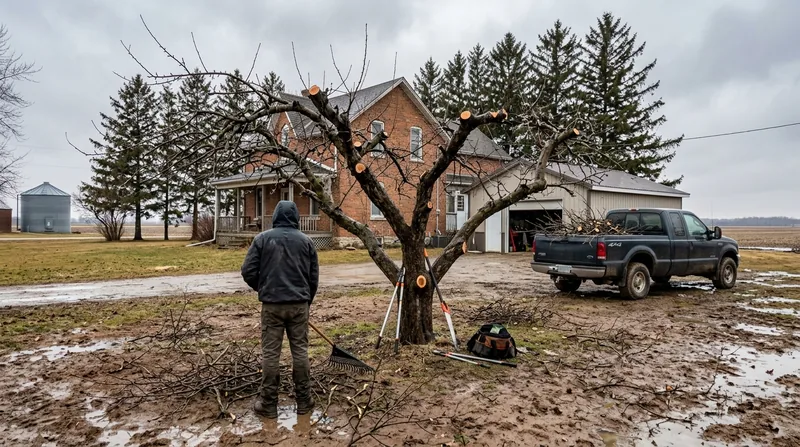




Fruit tree pruning in Windsor keeps your apple, pear, peach, plum and fig trees healthy, productive and within reach for picking. Our ISA Certified Arborists shape your trees for an open centre structure that lets light and air circulate, removes water sprouts and crossing branches that compete for nutrients, and maintains a manageable height suited to your property. Mature fruit trees in Windsor's residential neighbourhoods often become overgrown or neglected, producing fewer fruit and creating safety hazards. We work systematically to restore productivity and structure without shocking the tree. Call us at (855) 510-1827 for a free estimate, or visit our tree pruning service to learn how we handle structural work across the Windsor area.
Why Fruit Tree Pruning Matters
Unpruned fruit trees exhaust themselves producing weak growth and small fruit. Crossing branches rub and wound each other, inviting disease. Water sprouts shoot upward from the trunk and lower limbs, stealing energy from productive wood. Interior branches die from shading, leaving you with a dense, dark canopy that discourages fruiting. Windsor's humid climate and occasional ice storms make this worse: heavy, overgrown trees break more easily in storms, and dense foliage traps moisture that promotes fungal issues.
Regular pruning solves all of this. We remove dead and diseased wood, thin the crown to improve light penetration, cut away crossing or rubbing branches, and keep the tree at a height that lets you harvest safely from the ground or a short ladder. A well-pruned fruit tree produces more fruit, ripens it faster, and stays structurally sound through in Windsor and the surrounding area's freeze-thaw cycles.
- Remove water sprouts and vigorous vertical growth competing for resources.
- Clear crossing and rubbing branches that create wounds and disease entry points.
- Thin the canopy to allow sunlight and air movement into the interior.
- Maintain fruiting wood within easy picking height.
- Eliminate dead, diseased or damaged limbs that spread infection.
These steps restore vigour and yield to trees that have been neglected for years, even decades.
Local reality: Many fruit trees in Windsor were planted in the 1960s and 1970s but never pruned. A typical apple or pear tree that has not been touched in 10 years can yield 5 to 10 times more fruit after a single season of proper pruning, and the fruit is larger and ripens evenly.
How We Prune Fruit Trees in the Windsor Area
Our approach is methodical and respectful of the tree's biology. We start by removing all dead, diseased or obviously damaged wood. Then we thin the crown by removing branches that cross or rub, keeping the strongest and most horizontal limbs that produce the most fruit. We cut away vigorous upright shoots (water sprouts) that waste energy. Finally, we shape the tree to an open centre, where the main scaffold branches radiate outward and upward at wide angles, creating a vase-like structure that admits light and air to every part of the canopy.
We work in late fall through late winter, when trees are fully dormant and pruning wounds heal quickly. Cuts are made just outside the branch collar (the swollen ring where a branch meets the trunk), using sharp saws and secateurs to leave clean edges that close naturally. We do not use wound dressing or pruning paint; modern arboriculture favours letting trees seal their own cuts.
- Inspect the tree for dead, diseased or structurally weak wood before any cutting begins.
- Remove branches that cross, rub or grow inward towards the centre of the canopy.
- Cut away water sprouts and vigorous upright growth from the trunk and lower limbs.
- Thin scaffold branches to reduce crowding and improve light penetration.
- Shape the crown to an open centre, keeping fruiting wood within reach.
- Make all cuts just outside the branch collar and leave the tree to seal naturally.
Debris is chipped or hauled away, leaving your garden clean. Small branches fit in a standard green bin; larger wood can be removed in full by our crew.
Example in Sandwich: A 40-year-old plum tree was 8 metres tall with a dense, tangled canopy. After pruning, it was reduced to 5.5 metres, thinned by 40 per cent, and shaped to an open centre. The following season it produced three times the previous crop, and fruit ripened two weeks earlier because light reached every branch.
Pruning Techniques and Approach
Different fruit trees respond to different pruning strategies. Apple and pear trees tolerate aggressive thinning and do best with an open centre structure. Peach and plum trees fruit on one-year-old wood and need lighter, annual pruning to maintain a steady supply of young branches. Fig trees are vigorous and respond well to heading back to encourage branching. Our arborist assessment identifies the species, age and current condition of your tree, so we tailor the cut to its needs and your goals.
| Technique | Description | Best For |
|---|---|---|
| Open Centre Pruning | Remove the central leader and select 3 to 5 main scaffold branches radiating outward at wide angles. | Apple, pear, and young stone fruit trees. |
| Thinning | Remove entire branches at their base to reduce crowding and improve air flow and light penetration. | All fruit trees; especially dense, neglected trees. |
| Heading Back | Cut the end of a branch to an outward-facing bud to encourage branching and control height. | Fig, peach and plum trees; managing vigorous growth. |
| Deadwood Removal | Cut away all branches that are obviously dead, diseased, or damaged, back to healthy wood. | Any fruit tree; prevents disease spread and improves appearance. |
Our crew carries the right tools for each cut: hand saws for branches under 5 centimetres, pole saws for interior limbs, and climbing gear for tall trees that need interior work from above. We work safely and efficiently, and we respect overhead power lines: if a branch hangs over your service entrance wire, we clear it with proper approach distance; if it touches the public distribution lines of your local utility or Hydro One, we do not touch it and refer you to contact them directly.
Timing and Seasonal Considerations
Fruit tree pruning is best done in late fall through late winter, when trees are fully dormant. At that time, pruning wounds close quickly, and there is no risk of stimulating tender new growth that frost will damage. In Windsor, this window runs from November through March. Pruning during the growing season (spring and summer) can stress the tree and invite disease, though light deadwood removal or broken branch cleanup can be done anytime.
If your tree is severely overgrown, we may stage the work over two or three seasons rather than remove more than one-third of the canopy in a single year. This keeps the tree healthy and reduces stress. For emergency situations such as storm damage or a branch threatening a structure, we respond year-round at (855) 510-1827.
Cost and Free Estimate
Fruit tree pruning costs depend on the number of trees, their size, age, and current condition. A single mature tree typically costs between $150 and $400. A small orchard of three to five trees may run $450 to $1,200. Our crew will visit your property, assess each tree, discuss your goals (fruit production, safety, aesthetics), and provide a detailed free estimate with no obligation. Call (855) 510-1827 or visit our contact page to book your free assessment.
Rose City Tree Trimming is fully insured and has been serving Windsor and the surrounding municipalities since 2014. Our ISA Certified Arborists are trained in fruit tree biology and modern pruning standards. We clean up all debris and leave your garden ready for the growing season.
Prices Fruit Tree Pruning in Windsor — Indicative pricing
| Service | Price | Details |
|---|---|---|
| Single small fruit tree (under 5 metres) | From $150 | Apple, pear, peach or plum tree; basic thinning and shaping |
| Single mature fruit tree (5 to 8 metres) | From $250 | Full open centre pruning; deadwood removal; height reduction |
| Multiple trees (3 to 5 trees) | From $600 | Discounted rate per tree when pruning several at once |
| Severely neglected or overgrown tree | On quote | May require staged work over two seasons; free site assessment |
| Debris removal and chipping | Included | All branches hauled or chipped; garden left clean |
| Free estimate | No charge | Response within 24 hours at (855) 510-1827 |
Indicative prices; free, personalized estimate within 24h at (226) 602-8703.